
Overview
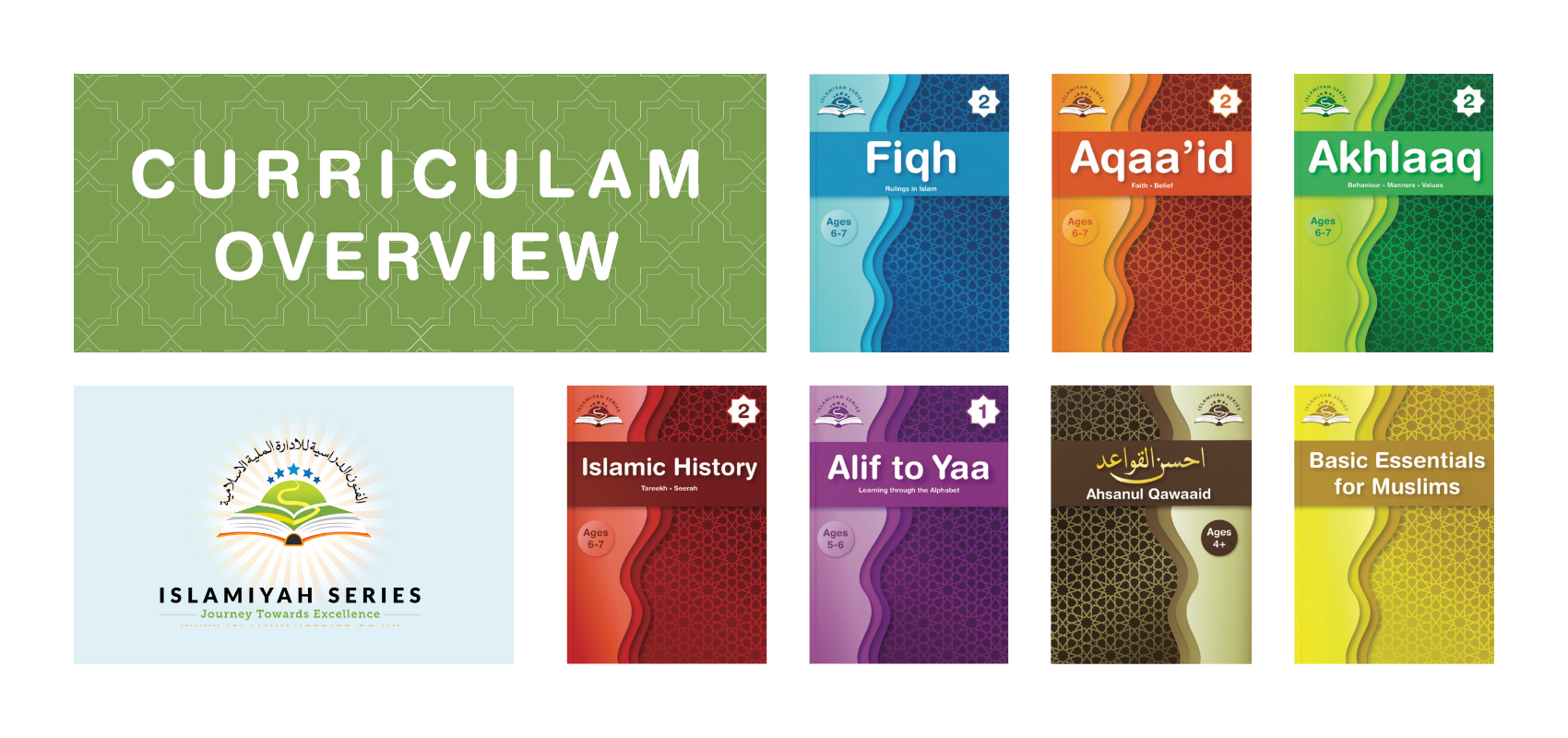
The Six Core Subjects of the Islamiyah Series
A Comprehensive Framework for Islamic Education
The Islamiyah Series has been carefully structured around six core subject areas that together provide students with a complete foundation in Islamic knowledge, practice and character development.
These subjects have been carefully sequenced and developed to ensure that students progress gradually from foundational concepts to deeper understanding.
The six core subjects are:
Together, these subjects aim to develop students who possess:
- Sound Islamic knowledge.
- Correct understanding of worship.
- Strong belief.
- Excellent character.
- Love for the Prophet Muhammad ﷺ.
- Confidence in practising Islam.
My First Book
Introducing Young Children to Islam
The earliest years of a child’s learning journey are extremely important. The purpose of My First Book is to introduce young learners to the foundations of Arabic and Islamic knowledge in an enjoyable and age-appropriate manner.
The book has been designed for children at the beginning of their Madrasah journey, introducing them to essential concepts through simple explanations, colourful presentation and engaging activities.
Children are introduced to:
- Arabic letters.
- Basic Arabic words.
- Islamic vocabulary.
- Pronunciation of Arabic terms.
- English meanings.
- Fundamental Islamic concepts.
Each Arabic word is supported with key learning points, helping children understand not only how to pronounce words but also their meaning and relevance.
The book also includes opportunities for students to practise writing Arabic letters, developing confidence from an early age.
Through this approach, children begin their Islamic education with a positive relationship with learning and develop familiarity with Arabic and Islamic terminology.
Ahsanul Qawāʿid
Building a Strong Foundation in Qur’anic Reading
Ahsanul Qawāʿid forms the foundation of a student’s journey towards reading the Qur’an correctly.
The objective of this subject is to ensure that students develop accurate pronunciation and understand the rules required for fluent Qur’anic recitation.
The curriculum introduces:
- Recognition of Arabic letters.
- Different forms of joined letters.
- Correct pronunciation.
- Harakāt:
- Fatḥah
- Kasrah
- Ḍammah
- Tanwīn:
- Fatḥatain
- Kasratain
- Ḍammatain
- Sukūn.
- Madd letters:
- Alif Maddah
- Yā Maddah
- Wāw Maddah
- Tashdīd.
The programme is structured over a two-year period, allowing students sufficient time to master each stage before progressing.
To support teachers and students, audio resources and PowerPoint presentations are also available.
The aim is not simply to enable students to read Arabic, but to develop correct pronunciation habits that remain with them throughout their lives.
Basic Essentials
Building the Foundations of Everyday Islamic Practice
Every Muslim requires essential knowledge that enables them to practise their faith correctly.
The Basic Essentials curriculum has been carefully compiled to provide students with the essential knowledge required for their daily lives as Muslims.
The curriculum spans approximately nine years, from Reception age through to Year 8, allowing students to gradually build their knowledge according to their age and ability.
Topics include:
- Kalimahs.
- Daily Duʿās.
- Selected Sūrahs.
- Forty Aḥādīth.
- Asmāʾ al-Ḥusnā.
- Essential Islamic teachings.
- Practical Wuḍūʼ.
- Practical Ṣalāh.
A key feature of this subject is its structured progression.
Rather than overwhelming younger students with excessive information, content is introduced gradually and reinforced through regular revision.
By completing this course, students develop the confidence to practise the essential aspects of Islam in their daily lives.
Fiqh
Understanding Islamic Practice
Fiqh provides students with the practical understanding required to fulfil their responsibilities as Muslims.
The objective of the Fiqh curriculum is not merely to teach rulings, but to help students understand how Islamic guidance applies to their daily lives.
Key topics include:
- Islamic terminology and definitions.
- Ṭahārah (purification).
- Wuḍūʼ.
- Ghusl.
- Ṣalāh.
- Ṣawm.
- Zakāh.
- Ḥajj.
- Contemporary issues and relevant rulings.
A unique feature of the Islamiyah Series Fiqh curriculum is its practical approach.
Students are encouraged to understand:
- What Muslims do.
- Why Muslims do it.
- How Islamic rulings apply in real situations.
The curriculum also incorporates updated masā’il (rulings) to ensure that students are prepared to understand challenges they may encounter in modern society.
Aqāʾid
Developing Strong Faith and Confidence
The purpose of ʿAqāʾid is to establish a strong foundation of Islamic belief.
A strong belief system provides students with confidence, stability and clarity in an increasingly complex world.
Students explore key areas including:
- Tawḥīd (the Oneness of Allah).
- Risālah (Prophethood).
- Ākhirah (the Hereafter).
- Angels.
- Divine Books.
- Challenges to faith.
The Islamiyah Series does not present beliefs merely as information to memorise.
Instead, lessons encourage students to understand:
- Why Muslims believe.
- How belief influences their lives.
- How faith provides guidance and purpose.
Through this approach, students develop a confident Islamic identity built upon knowledge and understanding.
Akhlāq
Developing Character and Values
Islam places great emphasis on character and manners.
The purpose of Akhlāq within the Islamiyah Series is to help students develop qualities that reflect the teachings of Islam in their interactions with others.
Topics include:
- Islamic manners.
- Respect.
- Honesty.
- Kindness.
- Good character.
- Avoiding negative traits.
- Rights of parents.
- Rights of people.
- Rights of creation.
Rather than teaching manners as a list of rules, the curriculum explores the reasons behind good behaviour.
Students learn that excellent character is not simply a social expectation—it is an essential part of being a Muslim.
The aim is to nurture individuals who are:
- Respectful.
- Compassionate.
- Responsible.
- Trustworthy.
- Positive contributors to society.
Sīrah
Learning from the Life of the Prophet Muhammad ﷺ
The Sīrah curriculum introduces students to the greatest example of humanity—the life of the Prophet Muhammad ﷺ.
However, the purpose of Sīrah is not limited to remembering historical events.
The curriculum focuses on reflection and application.
Students explore:
- The major events of the Prophet’s ﷺ life.
- His character and qualities.
- His relationship with Allah.
- His interaction with people.
- Lessons that can be applied today.
Through studying Sīrah, students develop:
- Love for the Prophet ﷺ.
- Appreciation of his sacrifices.
- Understanding of his character.
- Motivation to follow his example.
The ultimate goal is for students not only to know about the Prophet ﷺ, but to allow his teachings and character to influence their own lives.
A Complete Islamic Education Journey
Together, these six subjects create a balanced curriculum that develops every aspect of a child’s Islamic growth:
- Ahsanul Qawāʿid develops Qur’anic foundations.
- Basic Essentials builds daily Islamic practice.
- Fiqh teaches practical guidance.
- ʿAqāʾid strengthens belief.
- Akhlāq develops character.
- Sīrah inspires through the example of the Prophet ﷺ.
The Islamiyah Series therefore aims to produce students who are not only knowledgeable, but who understand, practise and embody the beautiful teachings of Islam.